
Summer Heat Wave Home Prep Checklist Without AC Upgrades
Reading time: 12 minutes
It’s July 2026, and your phone buzzes with a weather alert: a record-breaking heat dome is expected to settle over your region for the next ten days. Temperatures will climb past 105°F (40°C). Your neighbors are already panic-buying window units, and HVAC companies have a three-week waiting list. Sound familiar? For millions of households across North America, Europe, and Australia, this is the new normal — and upgrading your AC simply isn’t always an option.
Here’s the straight talk: you don’t need to spend thousands on air conditioning upgrades to survive — and even thrive — during a brutal summer heat wave. What you need is a strategic, layered approach to home preparation that works with the physics of heat, your home’s existing structure, and some clever behavioral adjustments.
This guide is your comprehensive playbook. Whether you’re in a rented apartment where you can’t install anything permanently, a heritage home with restrictions on modifications, or simply trying to cut costs while staying safe, this checklist is built for you.
Table of Contents
- Why Heat Wave Prep Matters More Than Ever in 2026
- Before the Wave Hits: Structural and Environmental Prep
- Window and Door Tactics That Actually Work
- Understanding Thermal Mass and Interior Heat Management
- Smart Ventilation Strategies
- Low-Tech and Low-Cost Cooling Tools
- Heat Strategy Comparison Table
- Behavioral Adjustments for Extreme Heat
- Frequently Asked Questions
- Your Heat-Proof Home: The Action Plan
Why Heat Wave Prep Matters More Than Ever in 2026
Global surface temperatures in 2025 broke records for the third consecutive year, according to data published by the World Meteorological Organization. In 2026, climate scientists at NOAA have confirmed that heat waves are now arriving earlier, lasting longer, and reaching higher peak temperatures than at any point in recorded history. The 2025 European Heat Convergence — a month-long event that saw temperatures above 42°C in parts of France, Spain, and Germany — resulted in over 47,000 heat-related hospitalizations across the continent.
In the United States, the Pacific Northwest and the Mountain West are experiencing heat events once classified as “once in a century” now occurring every three to five years. Meanwhile, cities like Phoenix, Las Vegas, and Dallas recorded their first-ever sustained overnight lows above 90°F in 2025.
The urgency is real. Heat is the deadliest weather phenomenon in the United States, responsible for more fatalities annually than hurricanes, floods, and tornadoes combined. The CDC estimates that over 1,500 Americans die from heat-related causes each year — a figure that researchers at Columbia University project could triple by 2050 without significant behavioral and infrastructure adaptation.
The good news? Most heat-related suffering is preventable with the right preparation. And the majority of effective strategies cost under $100 and require zero professional installation.
Before the Wave Hits: Structural and Environmental Prep
Think of heat wave preparation like storm prep. You wouldn’t wait until the hurricane is on your doorstep to board up windows. The same logic applies here. When a heat advisory is issued — typically three to five days before the event peaks — you have a critical preparation window.
Audit Your Home’s Heat Entry Points
Heat enters your home through several primary pathways: solar radiation through windows and roofs, conduction through walls and floors, and convection through gaps and poorly sealed openings. Before temperatures peak, do a systematic walkthrough:
- South- and west-facing windows are your biggest vulnerabilities in the Northern Hemisphere. Afternoon sun hitting these windows can raise indoor temperatures by 10–15°F in just a few hours.
- Attic spaces act as heat reservoirs. An unventilated attic can reach 150–160°F on a hot day, radiating heat downward into living spaces even after sunset.
- Dark exterior surfaces — dark roofs, dark pavement nearby, dark walls — absorb and re-radiate heat significantly more than light-colored alternatives.
- Air gaps and drafts around doors, window frames, electrical outlets, and pipe penetrations allow hot outdoor air to infiltrate, especially when outdoor temperatures are high.
Run a quick draft test: hold a lit incense stick near suspect areas on a hot day and watch the smoke. Any lateral movement indicates infiltration. Use temporary weatherstripping foam tape (available at any hardware store for under $10) to seal gaps immediately.
Prepare Your Outdoor Environment
Your immediate outdoor environment significantly impacts indoor temperatures. In the days before a heat wave:
- Water your trees and shrubs. Healthy vegetation provides evaporative cooling and shade. A mature tree can lower surrounding temperatures by 2–9°F through transpiration.
- Deploy shade cloth or temporary awnings over south and west windows. Even a $15 roll of garden shade cloth, hung with tension rods or clips, can reduce solar gain through windows by 50–70%.
- Move dark-colored outdoor furniture or containers away from windows and walls. These absorb heat and re-radiate it directly at your home’s exterior.
- Wet down hardscaping (patios, driveways) in the early morning during extreme heat events. Evaporation cools the surrounding air and reduces radiant heat load on your home’s exterior walls.
Window and Door Tactics That Actually Work
Your windows are both your biggest vulnerability and your most powerful tool during a heat wave. Managing them strategically — not just instinctively — makes an enormous difference.
The Blackout Curtain Technique
Standard curtains are nearly useless against radiant solar heat. The key is thermal blackout curtains or cellular shades, which create an insulating dead-air space between the glass and the room. Studies from the Lawrence Berkeley National Laboratory have shown that properly installed interior window coverings can reduce solar heat gain by 33–45% compared to uncovered windows.
For renters or those without blackout curtains, an effective DIY alternative is to tape heavy-duty emergency Mylar blankets (available for $1–3 each) to window frames with painter’s tape. The reflective surface bounces solar radiation back outward before it can warm your interior. Test this method first in a single room to verify it doesn’t violate any lease terms regarding window appearance from the exterior.
Strategic Window Opening: The Timing Protocol
One of the most common and costly mistakes during heat waves is opening windows during the day to “let air in.” Unless the outdoor temperature is lower than your indoor temperature, this warms your home rather than cools it. Follow this protocol instead:
- Close all windows and coverings at sunrise or when outdoor temperatures exceed indoor temperatures (usually around 7–9 AM in most heat wave scenarios).
- Keep everything sealed and shaded throughout the afternoon — this is when outdoor temperatures peak and solar radiation is most intense.
- Open windows once outdoor temperatures drop below indoor temperatures — typically around 8–10 PM during heat events. This is your nightly purge window.
- Maximize cross-ventilation during the open window period by opening windows on opposite sides of the home to create a flow-through effect.
Case study: During the 2025 Sacramento heat event, a UC Davis housing research team monitored 40 households using behavioral interventions versus 40 control households that used standard practices. The households using the disciplined window management protocol maintained interior temperatures an average of 8.3°F lower than the control group at peak afternoon temperatures — without any mechanical cooling whatsoever.
Understanding Thermal Mass and Interior Heat Management
One of the most underutilized concepts in non-AC heat management is thermal mass — the ability of materials to absorb, store, and slowly release heat energy. High thermal mass materials like concrete, stone, brick, and water take a long time to heat up and a long time to cool down. This property can be strategically leveraged in your home.
Here’s how to use thermal mass to your advantage:
- Fill large containers with water — buckets, jugs, even bathtubs — during cooler nighttime hours. These act as thermal “sinks,” absorbing heat during the day and moderating temperature swings. A bathtub filled with cool water can absorb significant ambient heat before it reaches a tipping point.
- Use ceramic tile, stone, or concrete flooring to your advantage by keeping it cool overnight (via fans or open windows) so it acts as a passive cooling surface during the day. Avoid covering thermal-mass floors with rugs during heat events.
- Move your activity to lower floors or basements. Ground-level and below-grade spaces have dramatically higher thermal mass due to contact with the relatively stable temperature of the earth (around 55–65°F year-round in most temperate climates).
- Avoid generating heat indoors during peak hours. Ovens, stovetops, clothes dryers, dishwashers, and even incandescent lighting add meaningful heat loads to your interior. Shift cooking to early morning, use a microwave or outdoor grill, and run appliances after 9 PM.
Smart Ventilation Strategies
Ventilation during a heat wave is a precision instrument, not a binary switch. The goal is to create nighttime cooling “charging” of your home’s thermal mass, then seal that coolness in for as long as possible during the day.
The Whole-House Fan Advantage
If your home has a whole-house fan (a large fan mounted in the ceiling that exhausts air to the attic), you have a powerful tool. Run it aggressively from around 9 PM to 2 AM to flush hot air out of living spaces and replace it with cooler outdoor air. Combined with open windows on the ground floor, a whole-house fan can drop indoor temperatures by 15–20°F in just 30–45 minutes on a cool night.
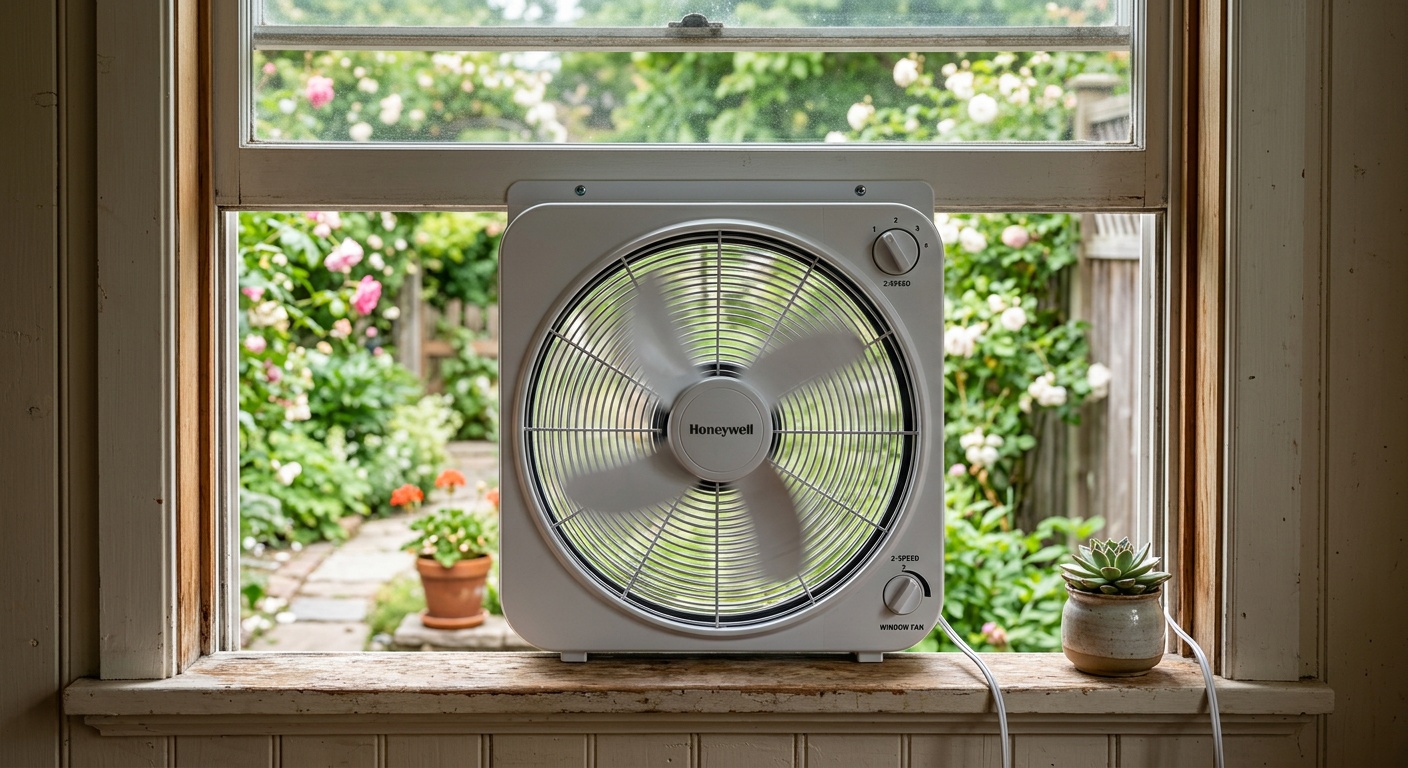
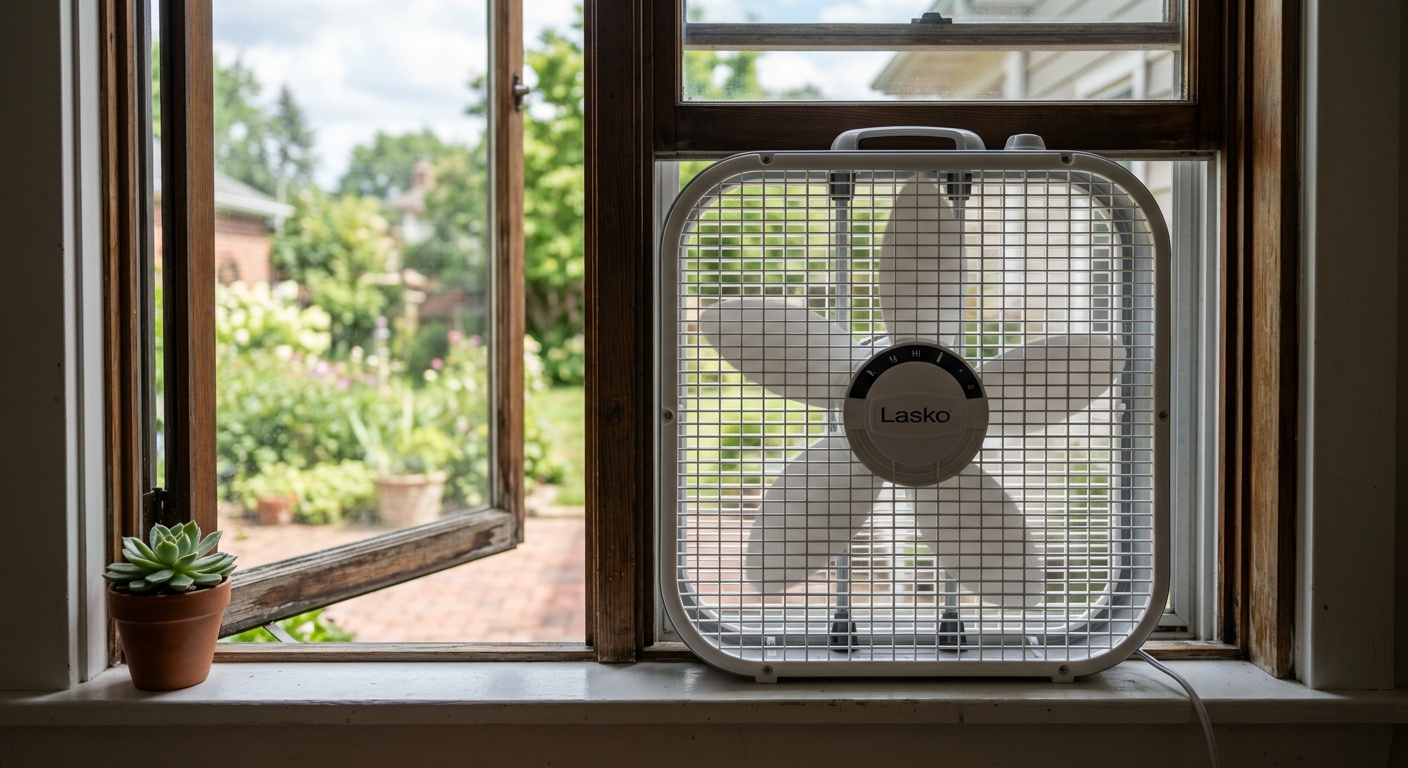
Don’t have a whole-house fan? Box fans placed in upper-floor windows facing outward — blowing air out of the house — combined with open lower-floor windows, mimic this effect with reasonable success. The key is directional exhausting, not just blowing air around.
Attic Ventilation Check
Before a heat wave hits, verify that your attic’s passive ventilation is unobstructed. Soffit vents (at the eaves) and ridge vents (at the peak) work together to allow hot air to escape naturally through convection. Blocked soffit vents — often obstructed by blown-in insulation — are one of the most common causes of overheated attics. A quick visual check and a few minutes with a broom can make a meaningful difference.
Low-Tech and Low-Cost Cooling Tools
Here’s where creative problem-solving meets practical physics. The following tools and techniques work on proven thermodynamic principles and can be deployed with minimal cost or installation effort.
Evaporative Cooling: Nature’s Air Conditioner
Evaporative cooling leverages the phase transition of water from liquid to vapor, which absorbs significant heat energy from surrounding air. In dry climates (below 50% relative humidity), this principle is remarkably effective. Tactics include:
- Wet towel method: Hang damp towels or sheets in doorways or over box fan intakes. As air passes through the moist fabric, it cools via evaporation. In a dry climate, this can drop air temperature by 5–10°F.
- DIY ice fan: Place a shallow pan or tray of ice in front of a box fan. As air passes over the ice, it drops in temperature. Replace ice as needed throughout the day.
- Misting fans: Battery-operated or plug-in misting fans use a fine water spray to create evaporative cooling in personal zones. These have become increasingly affordable in 2026, with quality units available for $25–60.
- Personal cooling textiles: Wet bandanas or cooling towels worn around the neck or on pulse points (wrists, temples) cool blood near the skin surface, reducing perceived temperature significantly.
For targeted room cooling solutions that go beyond basic fans, personal evaporative air coolers have gained significant traction in 2026 — particularly among apartment dwellers and renters who can’t install window units.
The Body Cooling Priority
During extreme heat, it’s crucial to understand that keeping your body cool is ultimately more important than keeping your room cool. The human body’s thermoregulation is sophisticated, but it has hard limits. Prioritize:
- Staying hydrated — at least 3 liters of water per day during extreme heat, more if active
- Wearing loose, light-colored, breathable fabrics (linen and bamboo excel here)
- Taking cool (not cold) showers every few hours to reset body temperature
- Sleeping with a damp, lightweight sheet rather than heavy bedding
Heat Strategy Comparison: Effectiveness and Cost
| Strategy | Estimated Cost | Temperature Impact | Ease of Implementation | Best For |
|---|---|---|---|---|
| Blackout Curtains / Mylar | $3–$80 | 5–15°F reduction | Very Easy | All home types |
| Strategic Window Management | $0 | 6–10°F reduction | Easy (behavioral) | All home types |
| Evaporative Cooling (fans + water) | $15–$60 | 5–12°F reduction (dry climates) | Easy | Dry/arid climates |
| Shade Cloth / External Awnings | $15–$120 | 8–18°F reduction (at window) | Moderate | Houses with exterior access |
| Thermal Mass Activation (water containers) | $0–$20 | 2–6°F stabilization | Easy | All home types |
Heat Management Effectiveness by Strategy
Blackout Curtains / Mylar
Strategic Window Timing
Evaporative Cooling (dry climates)
External Shade Cloth / Awning
Thermal Mass Water Storage
Effectiveness ratings based on composite data from energy research institutions (2025–2026). Results vary by climate, home type, and implementation.
Behavioral Adjustments for Extreme Heat
The structure of your home matters, but so does how you use it. Behavioral adaptation is one of the most powerful — and most overlooked — components of heat wave survival. Consider this real-world scenario:
Case Study — Portland, Oregon, 2025: During a 9-day heat event that pushed temperatures to 108°F, a community resilience study by Oregon Health & Science University tracked 200 households. The households that implemented structured behavioral protocols — including cooking schedule changes, activity time-shifting, designated cool rooms, and midday rest periods — reported 40% fewer heat-related symptoms compared to households that relied primarily on fans alone. Notably, none of the intervention households had central air conditioning.
Here are the most impactful behavioral shifts:
- Designate a cool room. Pick the lowest, most interior, least sun-exposed room in your home and concentrate your cooling efforts there. Close off all other rooms during peak heat to preserve cold air in one zone.
- Shift your sleep setup. Move your sleeping area to the coolest part of the house. Many heat wave deaths occur overnight when people sleep in overheated bedrooms. If the floor is cooler, sleeping on a mattress on the floor is a legitimate strategy.
- Use the buddy system. Check on neighbors, elderly family members, and anyone living alone daily during heat events. The majority of heat fatalities occur in people who are isolated.
- Identify cooling centers. Libraries, shopping malls, community centers, and movie theaters serve as publicly air-conditioned spaces during heat emergencies. Know your nearest options before the event peaks.
- Reduce physical exertion between 10 AM and 6 PM. If you must be active, do it before 8 AM or after 8 PM.
Frequently Asked Questions
Can these no-AC strategies keep me safe during a truly extreme heat event (above 110°F outdoors)?
The strategies in this guide significantly reduce indoor heat load and slow temperature rise, but they have limits at the extreme end of the spectrum. When outdoor temperatures exceed 105–110°F for multiple consecutive days without significant nighttime cooling, even the best passive strategies may not maintain safe indoor temperatures — particularly for vulnerable populations (elderly, infants, those with health conditions). In those scenarios, spending midday hours in an air-conditioned public space is strongly recommended. Use these strategies as your primary toolkit and community cooling centers as your backup for true extremes.
How effective are these methods in humid climates versus dry climates?
Evaporative cooling strategies — wet towels, ice fans, misting systems — are significantly less effective in humid climates (above 60–65% relative humidity) because the air is already saturated with moisture and cannot absorb additional water vapor efficiently. In humid climates like the American Southeast or Gulf Coast, focus instead on shade management, strategic ventilation timing, thermal mass, and behavioral adaptation. Desiccant dehumidifiers can also help by reducing humidity in your designated cool room, making the same temperature feel 5–8°F cooler due to reduced heat stress on the body.
What’s the single most impactful thing I can do if I only have time for one preparation step?
If you have only one action available, cover your south- and west-facing windows with reflective material before peak heat arrives. External shading is marginally more effective than internal coverings, but either provides substantial benefit. Mylar emergency blankets taped to the interior of sun-exposed windows can reduce solar heat gain by 40–60%, and they cost under $5. This single step can keep your home’s interior 8–12°F cooler during peak afternoon hours — a difference that can be genuinely life-saving during severe heat events.
Your Heat-Proof Home: The Action Plan
Heat waves in 2026 are not anomalies — they are the baseline. The good news is that you now have a comprehensive toolkit for managing them without breaking the bank or waiting on a contractor. Here’s your rapid-deployment checklist:
- 72 hours before peak heat: Cover south and west windows with blackout curtains or reflective material. Deploy exterior shade cloth if accessible. Seal gap drafts with foam weatherstripping. Fill water containers for thermal mass storage.
- 24 hours before peak heat: Pre-cool your home aggressively overnight with fans and open windows. Stock ice. Identify your cool room and move essentials there. Confirm the locations of nearby cooling centers.
- During the heat event: Seal the home at sunrise. Follow the window discipline protocol. Avoid heat-generating appliances from 9 AM to 9 PM. Keep cool room doors closed. Use evaporative techniques on yourself, not just your space.
- Each evening: Open windows once outdoor temperature dips below indoor temperature. Run fans to exhaust hot air and draw in cool air. Re-chill water containers for the next day.
- Ongoing: Check on vulnerable neighbors. Monitor the heat index, not just air temperature. Know when to access public cooling if your home’s temperature becomes unsafe.
The broader implication here goes beyond individual comfort: as climate patterns shift, the gap between those who can afford mechanical cooling and those who cannot is becoming a genuine public health fault line. Passive cooling knowledge, behavioral adaptation, and community solidarity are not just coping strategies — they are the foundation of climate resilience at the neighborhood level.
So here’s the question worth sitting with: If your community experienced a ten-day heat wave tomorrow with no power grid, no hardware stores, and no waiting for deliveries — how prepared would you and your neighbors actually be? The time to answer that question with action is now, not in the middle of a heat dome. Your prepared home could be the coolest refuge on the block — and possibly a lifeline for someone who needs it.
Article reviewed by Hans Müller, Industrial Architecture & Concrete Restoration Specialist, on July 15, 2026